© Official Site Of 555th Parachute Infantry “Triple Nickle”. 2008







Born March 24, 1926 in Camden, South Carolina
Decorated Army veteran and member of the 555 th Parachute Infantry Battalion,
or "Triple Nickles," the nation's first all-black parachute infantry test platoon,
company and battalion.


BIOGRAPHY
Lieutenant Colonel John E. Mann, a distinguished 33-year veteran of
the U.S. Army, has been awarded more than thirty U.S. and foreign
decorations. They include the Silver Star, three Legions of Merit,
three Bronze Stars and the Distinguished Flying Cross. Mann served
as a Special Forces advisor in Vietnam during 1963-64 and later as a
battalion commander in 1969. He was a member of the historic 555
th Parachute Infantry Battalion, the first all black paratroop unit,
known as the "Triple Nickles," and made 168 jumps as a paratrooper
over a period of 17 years airborne service. After retirement, he
authored four detective novels.
Mann was born March 24, 1926 in Camden, South Carolina to Otis
and Helen Mann. The couple had no other children. Mann graduated
from Mather Academy in 1944, was drafted into the Army shortly
afterwards at age 18 in October 1944. To further his education,
Mann took college courses in the evenings and in 1966 he received a
BA in History from Park College in Parkville, Missouri. In 1976 he
was awarded a Masters degree from the University of Oklahoma.
Mann also graduated from a number of military schools while in the
service, including the Company Grade Officers Course, Motor
Officers Course, Paratroop and Glider courses (all at Fort Benning,
Georgia) and the Command and General Staff College at Fort
Leavenworth, Kansas.
Upon graduating from high school, Mann reported to Fort Banks,
Massachusetts for his induction into the U.S. Army. He was then
transferred to Fort McClellan, Alabama, a segregated training
facility, staffed by white officers, for basic training.
After basic training, Mann was selected as cadre (drill sergeant)
where he trained troops for combat. Shortly after the war ended in
Europe, he was transferred to Fort Benning, Georgia, the home of
the Airborne School.
Although he had seen a film of airborne training previously, and was
impressed with the paratroopers' appearance, the manner in which
they carried themselves, plus the duty appeared to be exciting. It was
here that he had his first opportunity to see his first black
paratrooper. He volunteered for paratroop training but his
application was not forwarded, because he was considered,
"essential personnel." Since his term of service was about to end, he
was discharged and then re-enlisted for airborne duty in early 1947
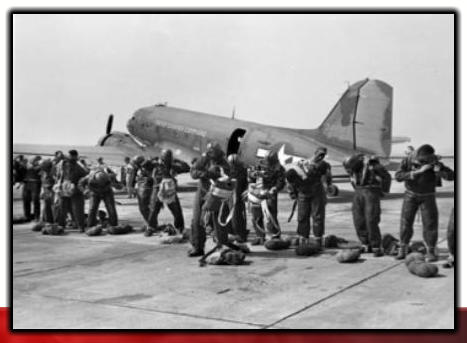
with the 555 th Parachute Infantry Battalion, known as the Triple
Nickles. It was the first and only all black battalion that served
during World War II. Although Mann was not part of the inaugural
units, he had the distinguished honor of serving with the
organization prior to its being integrated into the 82 nd Airborne
Division and becoming the 3 rd Battalion, 505 th Airborne Infantry
Regiment. Shortly after the Korean War began, Mann was sent as a
part of a cadre to the 11 th Airborne Division at Fort Campbell,
Kentucky to help replace units from the division that had been
shipped to Korea.
He became a company First Sergeant at 24 years of age and later
received a direct commission as a Second Lieutenant. Mann served
as a First Lieutenant in the closing months of the Korean War and
was given the command of a company in the 3 rd Infantry Division.
Upon his departure, he was awarded his first Bronze Star. Later, he
was assigned again to the 11 th Airborne Division and while serving
on a peace-keeping mission during the Cold War in Germany, was
sent to Lebanon in 1958. His company secured a hill overlooking the
Beirut Airport and guarded the American Embassy residence. Later,
the company moved to the olive grove in the vicinity of the Airport
and conducted patrols. He was promoted to Captain while in
Lebanon. After completing special forces and counter-insurgency
training, Mann was assigned to 1st Special Forces Group (Abn) on
Okinawa, and sent as a detachment commander to Vietnam to train
Hamlet Militia and to establish a camp in Bien Dinh Province.
He conducted one of the first heliborne operations in country by
securing the new camp-site while the remainder of his "Strike-
Force" came by vehicle over land. Later he was instrumental in
preventing an uprising when one of the three Montagnard
Companies left the camp without approval of the camp commander.
Mann went after the force and was able to return the troops back to
the camp the following day. Mann returned to Vietnam in 1968 and
served on the Division Staff in the 25 th Infantry division and later
as battalion commander. He saw considerable combat and earned
numerous medals and commendations for his valor in battle.
After his service in Vietnam, Mann returned to a job in the Pentagon
as an executive officer in the Warsaw Pact division (DIA) until
1973. He was next sent to The Netherlands to serve as commander
of the American Army troops assigned to Allied Forces Central
Europe headquarters. (NATO) Unfortunately, his wife, Grace died of
cancer while they were there.
Mann returned to the U.S. in 1977 and finished his last year of
service at Fort Lesley J. McNair in Washington, DC before retiring
as a lieutenant colonel.
In 1978, Mann met with former members of the Triple Nickles at
Howard University to plan their first reunion that would take place at
Fort Bragg, North Carolina in 1979. Since then, they have had a
reunion practically every year. As a civilian, Mann was appointed
County Personnel Officer for Prince George's County Maryland,
from 1979-1981, before taking a position as business manager of
Glenelg Country School in Howard County Maryland. Mann
married his second wife, Jean, in 1987 and retired from Glenelg
Country School in 1991.
After attending a seminar at his local library in the early 1990s,
Mann joined Sisters in Crime, a fiction, mystery writing group.
Since 2003, Mann has published four books based on the fictional
character, Joe Kepper, a former paratrooper, turned police detective:
The Search for Rosita (2003), Peril in Parksdale (2004), Angelo's
Guest (2007), and Early Joe Kepper (2009) .
Mann continues to maintain and promote the legacy of The Triple
Nickles paratroopers through annual reunions, and correspondence
with formal members. He also talks to groups upon request. He has
visited Graterford Prison in Pennsylvania, which has a chapter of
Vietnam Veterans of America who were interested in America's first
black paratroopers (the prisoners presented him with a plaque) and
more recently he spoke to cadets at the Naval Academy in
Annapolis.

John E. Mann is a freelance
writer published in a number
o0f national magazines and
newspapers. He has also
been honored with several
poetic achievement awards.
John is a graduate of Park
College and holds a Masters
Degree from the University of
Oklahoma. He has also
completed writing courses
with Long Ridge Writers
Group in West Redding,
Connecticut. John is a
retired Army officer who has
been awarded more than
thirty US and foreign
decorations. They include
The Silver Star, three Legions
of Merit, three Bronze Stars
and the Distinguished Flying
Cross.